ESS System Load Sharing
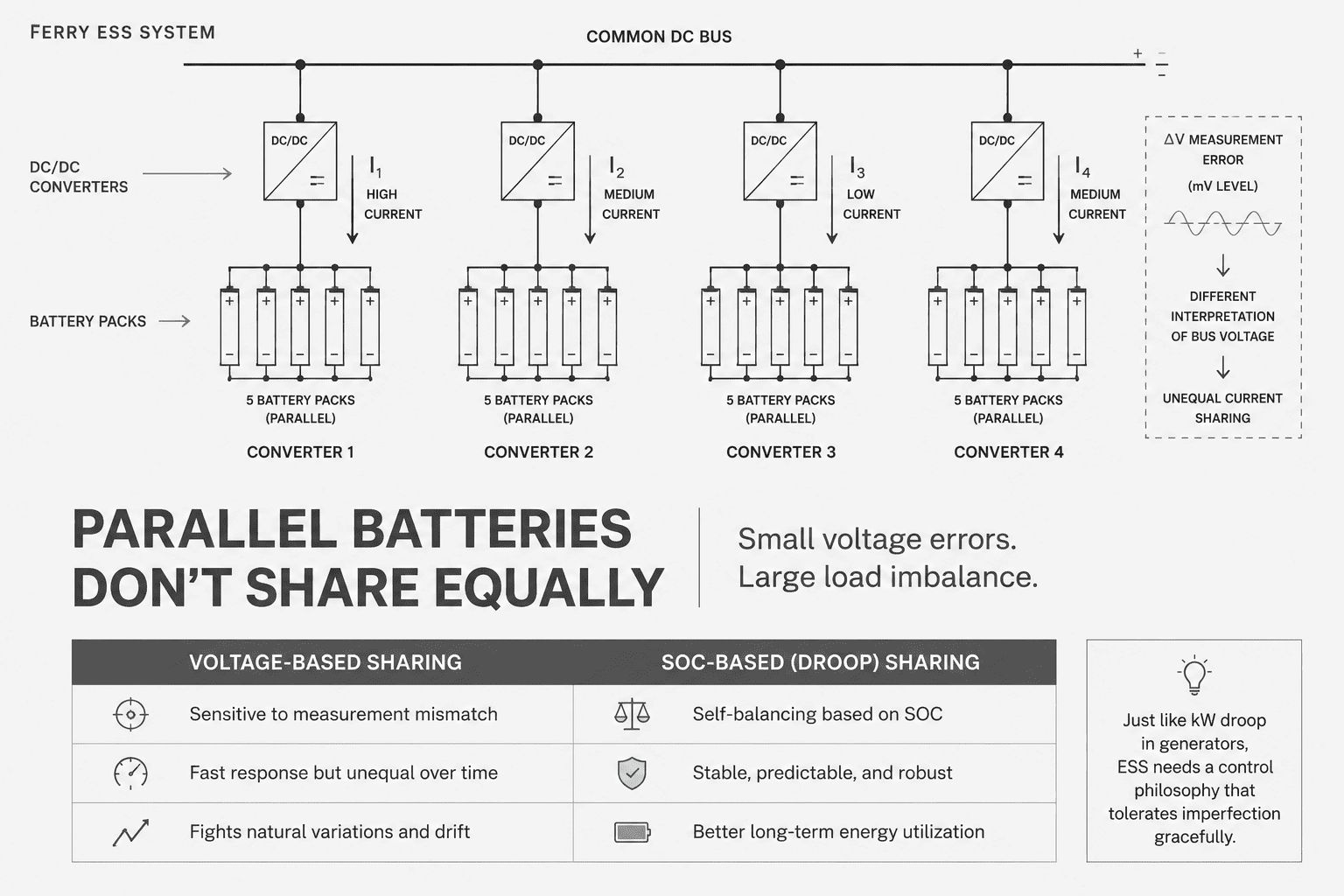
Most engineers assume parallel battery systems naturally share load equally. They don’t. And small measurement errors can quietly destroy your energy balance strategy.
We saw this on a ferry ESS system recently.
4 DC/DC converters connected to a common DC bus. Each converter controlled 5 parallel battery packs behind it. Everything looked perfectly symmetrical on the drawings. But in operation, some battery groups were discharging much harder than others.
Why?
Tiny DC bus voltage measurement differences. One converter measured the bus slightly lower → pushed more current. Another measured slightly higher → backed off. Nothing was “faulty”. The control philosophy was.
This is the exact reason conventional generators use kW droop sharing. Because real systems are never identical: sensors drift, impedance differs, response times vary, converters don’t react equally.
Trying to force perfect equality usually creates instability. That’s why I suggested SOC-based load sharing.
Very similar philosophy to droop control: higher SOC batteries contribute more, lower SOC batteries contribute less. Simple idea. But it makes the system naturally self-balancing over a period of time instead of fighting physics.
A lot of ESS designs today still treat batteries like ideal DC sources. They’re not. The best load sharing strategy is usually the one that tolerates imperfection gracefully.
Curious what others are seeing in marine ESS and microgrid systems: droop? master-follower? SOC balancing? virtual impedance?