Droop Vs Master-Follower
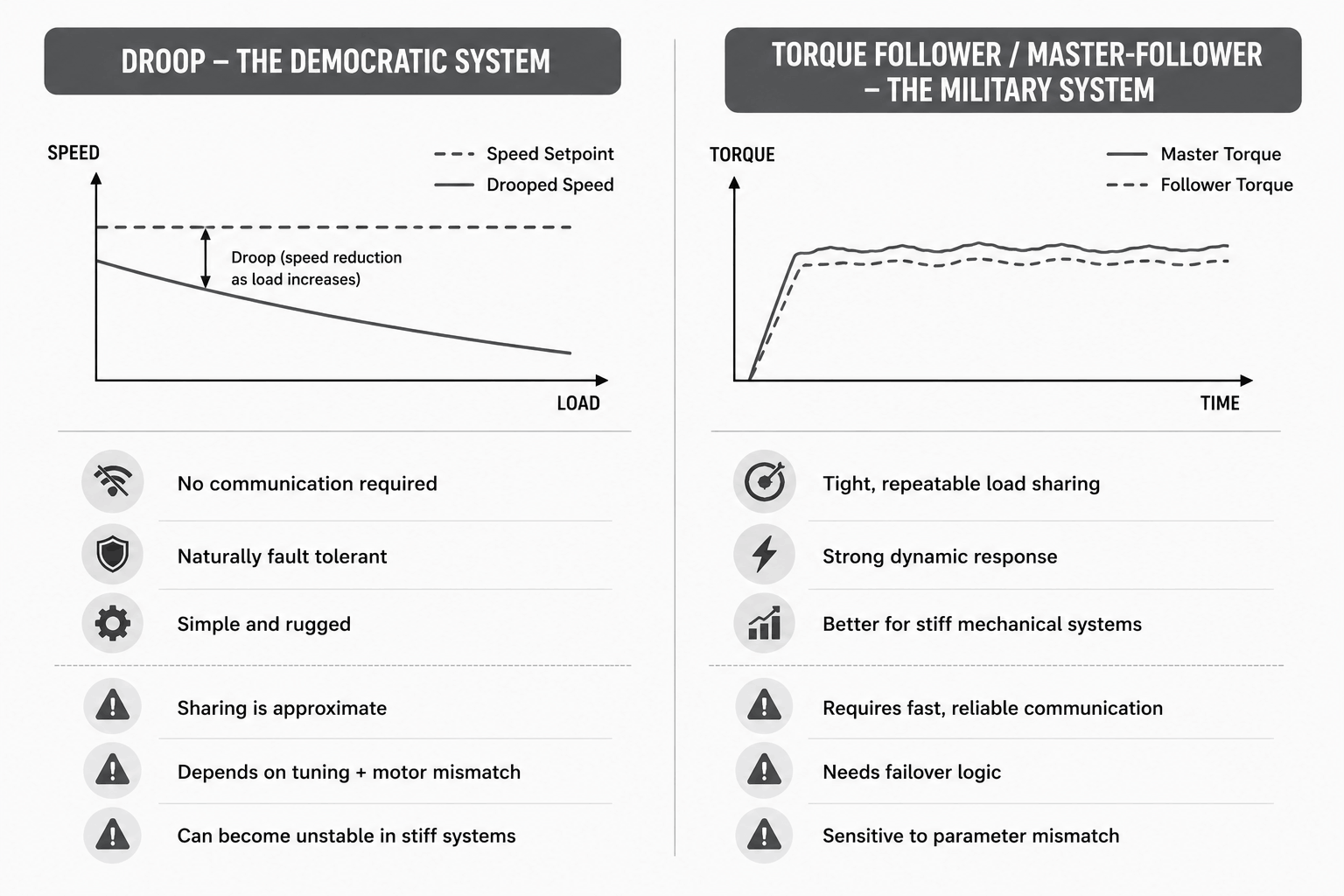
Droop looks old-fashioned until you see a badly tuned master-follower system.
Then suddenly the “old” method starts looking very smart.
We had multiple drives on a common shaft.
All in speed control.
All tuned “correctly.”
Still… one motor was pulling hard while another was regenerating into the DC bus.
Here’s the reality:
Speed is controlled.
Torque is negotiated.
And if you don’t define that negotiation properly,
the drives will do it themselves.
Usually through oscillation.
Two Philosophies of Load Sharing:
Droop → The Democratic System
Each drive says:
“If I’m overloaded, I’ll slow down slightly.”
That speed drop naturally shifts load to others.
Simple.
Rugged.
Fault tolerant.
Perfect for systems like mud pumps where the mechanics and fluid system are forgiving.
But…
Sharing is approximate.
And stiff systems can become unstable quickly.
Torque Follower → The Military System
One drive says:
“Here’s the torque. Match it.”
Everyone follows.
Precise.
Fast.
Excellent for top drives and drawworks “if designed well”.
But this is the part people underestimate:
Master-follower can become absolutely chaotic if not designed properly.
Slow communication?
Followers chase the master.
Unequal torque loop bandwidths?
Oscillation.
Encoder filtering mismatch?
Hunting.
Poor current regulator tuning?
One drive reacts faster and starts hogging load.
Now one motor motors.
Another regenerates.
And suddenly you’re debugging random DC bus overvoltage trips at 2 AM.
Honestly, before redesigning the entire control philosophy, I would first explore:
Droop tuning improvements
Torque loop bandwidth alignment
Encoder filtering
Current regulator tuning
Speed loop normalization
Inertia compensation
Communication timing improvements
Because many “bad load sharing” problems are actually tuning and system-dynamics problems.
Not philosophy problems.
Have you seen follower systems become unstable on stiff drivetrains?
What ended up fixing it?