Cooling System Availability
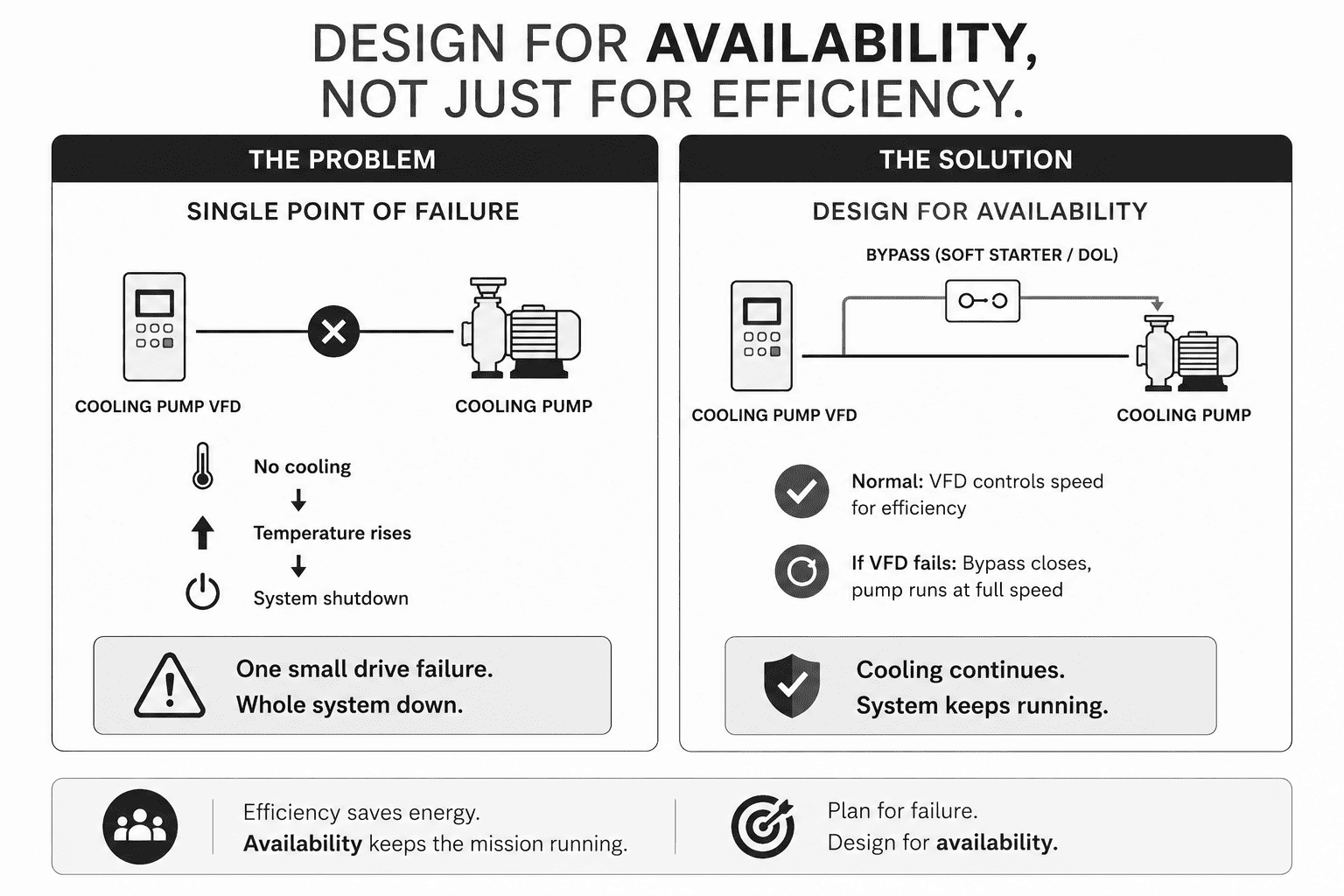
I’ve lost count of how many critical electrical systems I’ve seen brought down by… a cooling pump VFD.
Not the propulsion drives. Not the AFE. Not the DC/DC converters. A small cooling drive.
On paper, using a VFD for cooling pumps makes perfect sense. Lower energy consumption, better temperature control, softer starts, and reduced hydraulic stress.
But here’s the question I keep asking during commissioning: Should an auxiliary system ever become a single point of failure for a mission-critical system?
If a cooling VFD trips, the converters overheat. The converters shut down. Suddenly, healthy propulsion drives and power converters are sitting idle because one small drive failed. That’s a design problem, not a hardware problem.
My preference is simple:
If there are three or more independent cooling lineups, redundancy can often be achieved by distributing the load across multiple pumps and/or using of crossover valves. Losing one lineup shouldn’t stop the vessel—it should simply reduce available cooling capacity (or not if over sized) while the remaining pumps pick up the load.
But with one or two lineups, I’d seriously consider a VFD + bypass soft starter (or direct-on-line bypass) arrangement.
Operate on the VFD during normal conditions. If the drive fails, bypass it and run the pump at full speed. Yes, you’ll lose efficiency. But you’ll keep the cooling.
And more importantly, you’ll keep the vessel operating until maintenance can be planned.
We spend so much time designing redundancy into propulsion, generators, and power electronics. Maybe it’s time we apply the same thinking to the systems that keep them alive.
How do you approach cooling pump design on your projects? Maximum efficiency, or maximum availability?
#MarineEngineering #Automation #PowerSystems