Bow Thruster Energy Efficiency
Most marine decarbonization discussions are about million-dollar technologies.
Batteries.
Hydrogen.
Ammonia.
Methanol.
Wind-assisted propulsion.
They’re all important.
But sometimes, one of the biggest opportunities is hiding behind a parameter that nobody has questioned in years.
Recently, we were working on a small energy efficiency project aboard a RoPax ferry in Germany. One auxiliary system caught our attention: the bow thruster.
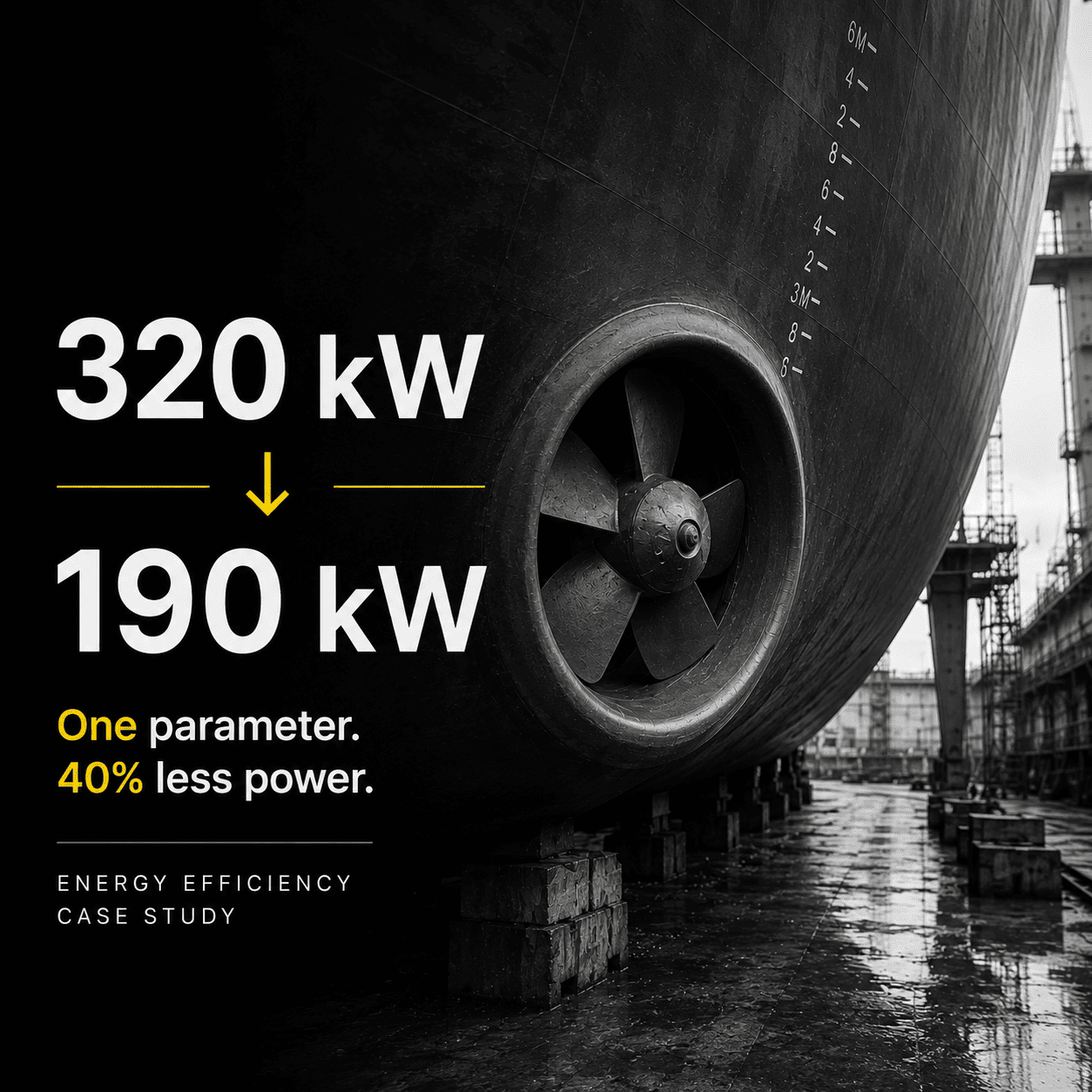
Like many vessels, it remained in idle mode before arriving in port. Although it wasn’t producing any thrust, it was still drawing approximately 320 kW through a Siemens VFD operating in V/f mode.
At first glance, nothing seemed unusual. The system was doing exactly what it had always done.
But one question kept coming up: Was the thruster actually idling at the lowest operating point it needed?
So instead of accepting the existing settings, we started digging. We reviewed the operating requirements. We challenged the assumptions. We tested a different approach.
The result?
Power consumption dropped from 320 kW to 190 kW.
That is over 40% less power, without replacing a single piece of hardware.
What changed? We simply reduced the idle frequency from 45 Hz to 40 Hz.
No new motors.
No new drives.
No expensive retrofit.
Just a better operating strategy.
Now let’s put that into perspective. If the thruster spends only 1.5 hours per day in this idle condition, that’s approximately:
✔️ 195 kWh saved every day
✔️ More than 71 MWh saved every year
✔️ Roughly 14 tonnes of marine fuel avoided annually*
✔️ Around 46 tonnes of CO2 emissions prevented every year*
Now imagine scaling that across a fleet:
A fleet of 10 vessels saves more than 700 MWh annually.
A fleet of 100 vessels saves over 7 GWh of electricity every year while avoiding approximately 1,400 tonnes of fuel and 4,600 tonnes of CO2 emissions.
All from rethinking one operating parameter on one auxiliary system.
The shipping industry contributes roughly 3% of global greenhouse gas emissions, and achieving our decarbonization goals will require alternative fuels, batteries, shore power, and new propulsion technologies.
But we shouldn’t overlook the opportunities that already exist onboard today’s vessels.
Every ship has equipment operating in standby, partial load, or idle.
Pumps.
Fans.
Compressors.
Thrusters.
HVAC systems.
Hydraulic power units.
How many of those operating points were chosen years ago… and simply never questioned again?
As engineers, we often get excited about designing the next breakthrough. But sometimes the greatest impact comes from asking a simple question:
“Do we really need to operate it this way?”
Because the cleanest kilowatt is still the one you never have to generate.
#MarineEngineering #Decarbonization #EnergyEfficiency #MaritimeIndustry #Sustainability #VFD #Automation